 senn-tech
84 days to decompile a game, twelve clone apps in a week: what software actually costs
Two videos reached us this week, both about taking other people's software apart and writing it again. Both quote numbers that survived our check, and both stop before saying what the numbers mean. A Nintendo 64 game was fully decompiled in 84 days where its own sequel needed 596. Between September 30 and October 7 twelve open-source programs appeared on GitHub that are modelled on Adobe and Microsoft applications. We went to the repositories, the status documents and the author's own blog. The figures hold, the reading of them needs three corrections.
What the 84 days prove and what they do not
On August 26, 2026 Chris Lewis reported the first Snowboard Kids as 100 percent decompiled. He means matching decompilation: every function has a C implementation that, compiled with the historic compiler, yields bit-identical machine code to the original. That is the strictest variant in this scene and it is checkable.
| Project | Days | Functions | Code |
|---|---|---|---|
| Snowboard Kids, finished 19.08.2026 | 84 | 2,145 | 732 KB |
| Snowboard Kids 2, finished 17.05.2026 | 596 | 2,995 | not stated |
| Pilotwings 64, human team, finished 10.04.2026 | 74 | 1,791 | roughly 838 KB |
The 596 days belong to Snowboard Kids 2, finished in May 2026, the 84 to the first game, completed three months later, and the video has that order right. Lewis himself supplies the reasons why this is not a clean speed proof for AI. The newer game is smaller, 2,145 functions against 2,995. He came into it with nearly two years of experience on the earlier project. The compiler situation differed, and the specialists of the scene stayed involved. About 4.8 percent of the commits he classifies as function work contain an expert intervention, roughly 41 commits. His own estimate without their help: the project would have stalled around 89 to 90 percent. Pilotwings 64 shows the other side of the same finding, a motivated human team finished that one in 74 days.
His closing line is the useful one. A hundred percent match means C code exists for every function, and it means no understanding of what those functions do. The first step got cheap, the second stayed expensive.
Twelve programs in one week
The GitHub organisation storytold, behind the AI studio ArtCraft, holds 48 repositories. Twelve of them are the Craft programs, created on September 30, October 1 and October 7, with a launcher added on October 9, measured through GitHub search on October 11 at about 19:20 UTC. PhotoCraft, the Photoshop model, carried 46,507 stars that day under the Apache-2.0 licence, with an MIT licence file in the repository as well.
The progress figures are self-assessments and they move. The video quotes PhotoCraft at a quarter to a third of professionals able to work with it daily, an assessment dated October 5 that the project has since replaced. The standing in its own documents on October 11:
| Program | Stage | Readiness for daily work, the project's own figure |
|---|---|---|
| PhotoCraft, modelled on Photoshop | alpha | about 45 %, range 40 to 50 % |
| WordCraft, modelled on Word | alpha | about 60 %, range 55 to 63 % |
| SoundCraft, modelled on Pro Tools | pre-alpha | about 40 %, with 94 % of menu items covered, measured |
GridCraft, the spreadsheet variant still described as pre-alpha in the video, now reads alpha. Two details make these numbers usable. First, the features are counted against installed originals; WordCraft's ribbon coverage is 428 of 450 commands, measured, 95.1 percent. Second, the projects state the remaining effort in a new unit, agent-hours. PhotoCraft lists 1,100 to 1,800 sequential hours of a single agent to beta and 2,300 to 4,100 to about 95 percent, calibrated against 1,004 merged pull requests. End to end that is 46 to 75 days of continuous running for beta and 96 to 171 days to close in on the original. The project says about 80 percent of it parallelises.
One inconsistency while counting. The README lists 15 missing tools, the roadmap of October 11 counts 56 of 68 and therefore 12 missing, the parity assessment counts 59 of 68. Three documents of the same day, three numbers. Anyone judging such a project should read the measurement documents before the shop window.
The console does not run inside an emulator
AnyPS5 has been public since August 3, C++, GPL-2.0, measured on October 11 at 19:20 UTC at 29,390 stars, 2,525 forks and 638 open issues, with the last commit that day at 12:42 UTC. What is described there is not an emulator. A relinker converts the executable into the native target format for Linux or Windows, and system library implementations come along with it. The line No emulation or separate runtime process is verbatim in the README. The project's own status page reports 85.81 percent, 2,903 of 3,383 functions, and the footnote explains the denominator honestly: the count covers what the project has declared so far, which says nothing about the real function surface of a PlayStation 5.
The compatibility list holds two entries. Dreaming Sarah is playable at 60 frames per second on a GTX 1050 Ti and 36 on an Intel HD 620. DOOM Shareware runs as a homebrew port, with open pull requests for the further levels. The game in the video headline, Dead Cells, is not on that list, so the headline describes a third-party demonstration. The disclaimer fits that reading: the project is positioned for interoperability, research and preservation, and states that it contains, distributes and requires no copyrighted software, firmware, keys or proprietary libraries. Unpacking and decryption sit deliberately outside it; a side repository from October 8, pkg-to-anyps5, takes care of pulling debug packages apart. Around that boundary several further projects formed within six weeks, a macOS port on September 26 and an iPad route on October 5.
One designer, no company
The image editor Compositor by Robbie Tilton is a different case because nobody is building a suite. The repository was created on September 16, Swift, MIT licence, 15,850 stars on October 11. The README states the motive directly, the price of Photoshop and the experience that GIMP never felt right for his work. One further line matters more to us than the stars. A project is a folder of PNG layers plus a manifest, and an open project updates live while it is being written. An agent can add layers into that folder and the result appears in the window, so agent readiness here is implemented rather than announced.
Two legal questions that easily merge into one
The distinction the second video draws survives scrutiny. Decompiling means translating existing code back. A clean-room rebuild means observing behaviour and writing the functionality again without ever seeing the original code. PhotoCraft puts it in one sentence in its README, implemented from public specs and observed behaviour only, no proprietary code, shaders or assets.
Legally these are two levels and the second one is usually skipped. For translating code back, EU law has the interoperability exception in Article 6 of Directive 2009/24/EC, and a contractual ban may not hollow it out under Article 8. Our article REA hit 83,000 GitHub stars in 44 hours. We measured the curve works through the four conditions of that exception. Independent of that stands the protection of technical measures under Article 6 of Directive 2001/29/EC, the Court of Justice ruling in Nintendo against PC Box of January 23, 2014, and in the United States section 1201 of the Copyright Act. That level touches every copy that first has to be decrypted, however clean the later translation is. Vendor EULAs add their own bans on top, at Adobe in two places of one document. Section 3.3(b)(2) of the general end user licence dated February 19, 2015 forbids reverse engineering, decompiling and disassembling, and item 4 forbids circumventing technical measures as well. For the European Economic Area, section 10.2(b) then states that nothing in those terms limits any non-waivable right to decompile, where that is necessary for interoperability and the information is not available. A written request comes first, the work has to be done by the licensee or someone acting for them, and the information may not be passed on. The contract thus accepts a limit the contract does not set. How much those clauses bind a team that never accepted them remains open.
The documents we read leave one question aside. They state the clean-room sentence and stay silent on how the training data of the models used was handled. Until that is answered, the cleanliness is an intention.
We started all twelve in a browser
Next to the installers, each Craft program's release page carries a file named <program>-web-<version>.zip. It holds a static site with one WebAssembly file, so a plain web server is enough. We tried that on October 11: a virtual machine on our Proxmox host, Ubuntu 26.04.1, Caddy as the web server, all twelve zips unpacked unchanged. The test site is reachable from our own network only, with a valid certificate and behind our allowlist.
We checked each program's start screen in an automated Chromium on Windows 11. Eleven of twelve started without an error message and showed their interface with sample content.
| Program | Version | Unpacked | What showed at start |
|---|---|---|---|
| GridCraft | 0.5.0 | 17 MB | Sample workbook with table, bar and pie chart, sparklines |
| WordCraft | 0.5.0 | 35 MB | Blank document, ribbon laid out like Word |
| DeckCraft | 0.5.0 | 29 MB | Sample deck of eight slides with sections and speaker notes |
| CADCraft | 0.5.0 | 15 MB | Blank drawing, layers, properties, command line |
| SoundCraft | 0.5.0 | 13 MB | Session with nine tracks, waveforms, bar grid |
| PhotoCraft | 0.7.0 | 25 MB | Tool bar, colour and layers panels, new-or-open dialog |
| VectorCraft | 0.9.0 | 54 MB | Start page with templates, German interface (follows the browser) |
| FilmCraft | 0.6.0 | 42 MB | Demo project with preview, timeline, two video tracks, loudness meter |
| LightCraft | 0.6.0 | 196 MB | Library with sample photos, histogram, exposure and contrast sliders |
| PdfCraft | 0.6.0 | 39 MB | Tool list, privacy note, open-file dialog |
| DesignCraft | 0.6.0 | 42 MB | Start page with page sizes and a sample magazine |
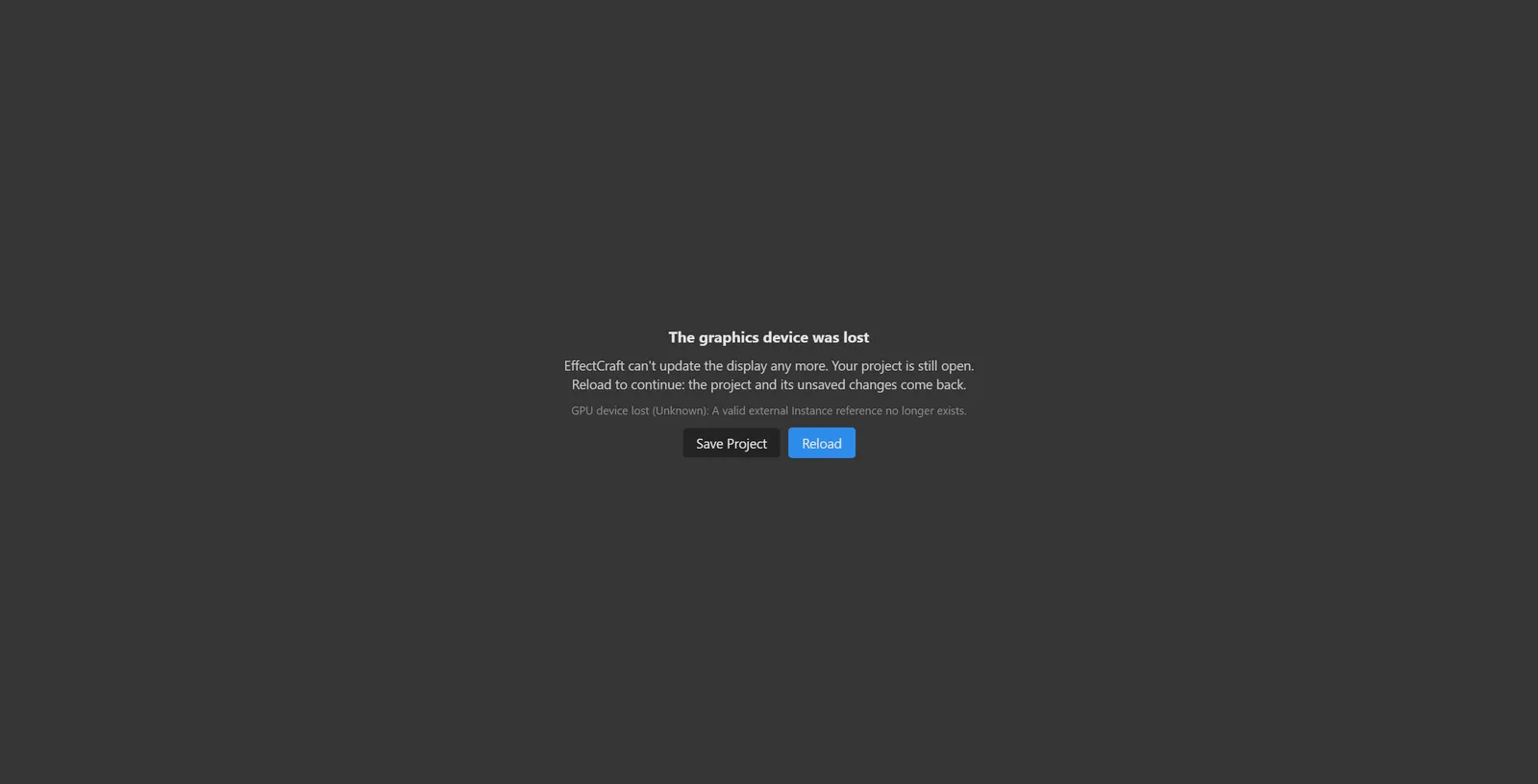
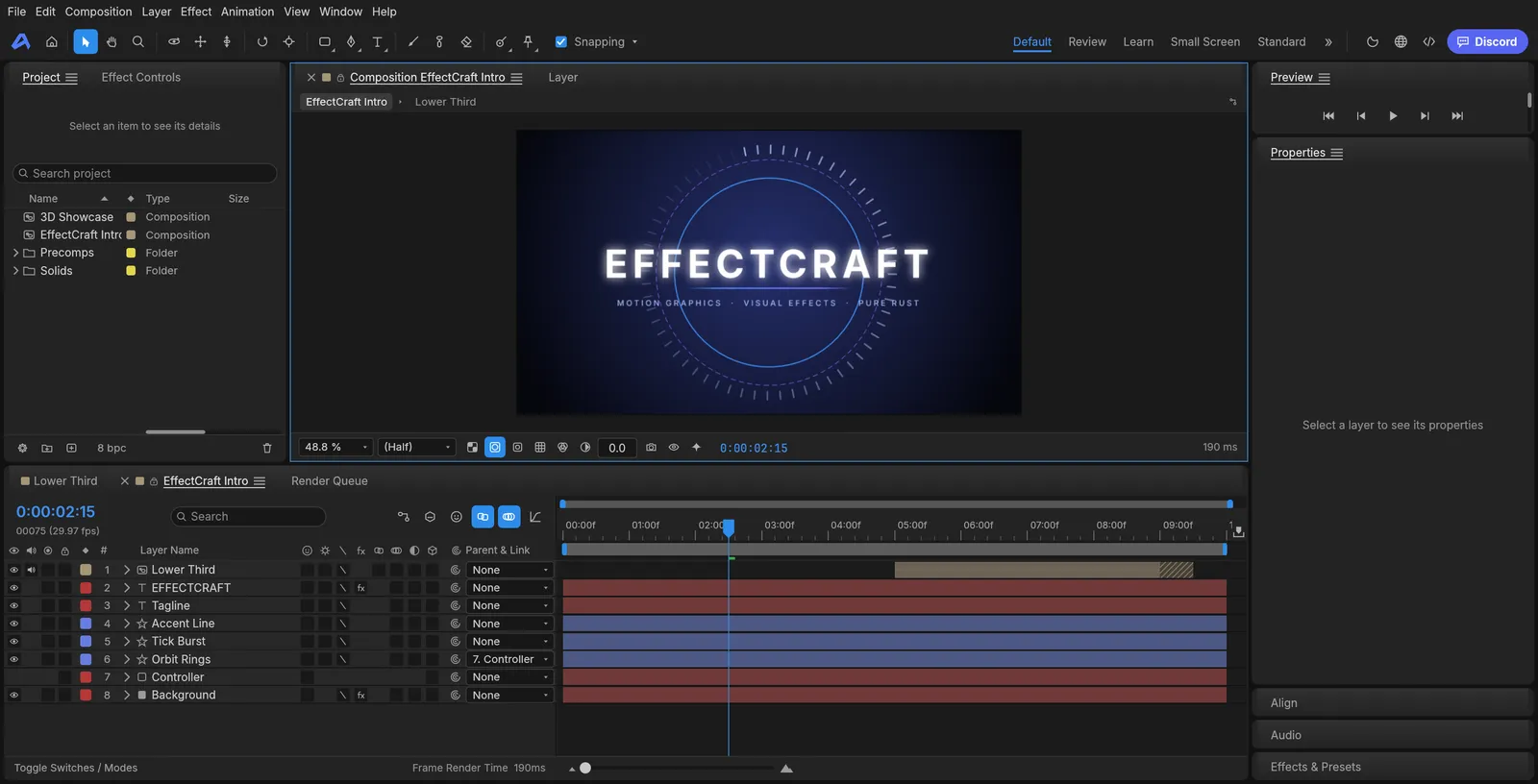
| EffectCraft | 0.8.0 | 59 MB | See below, the graphics device was lost |
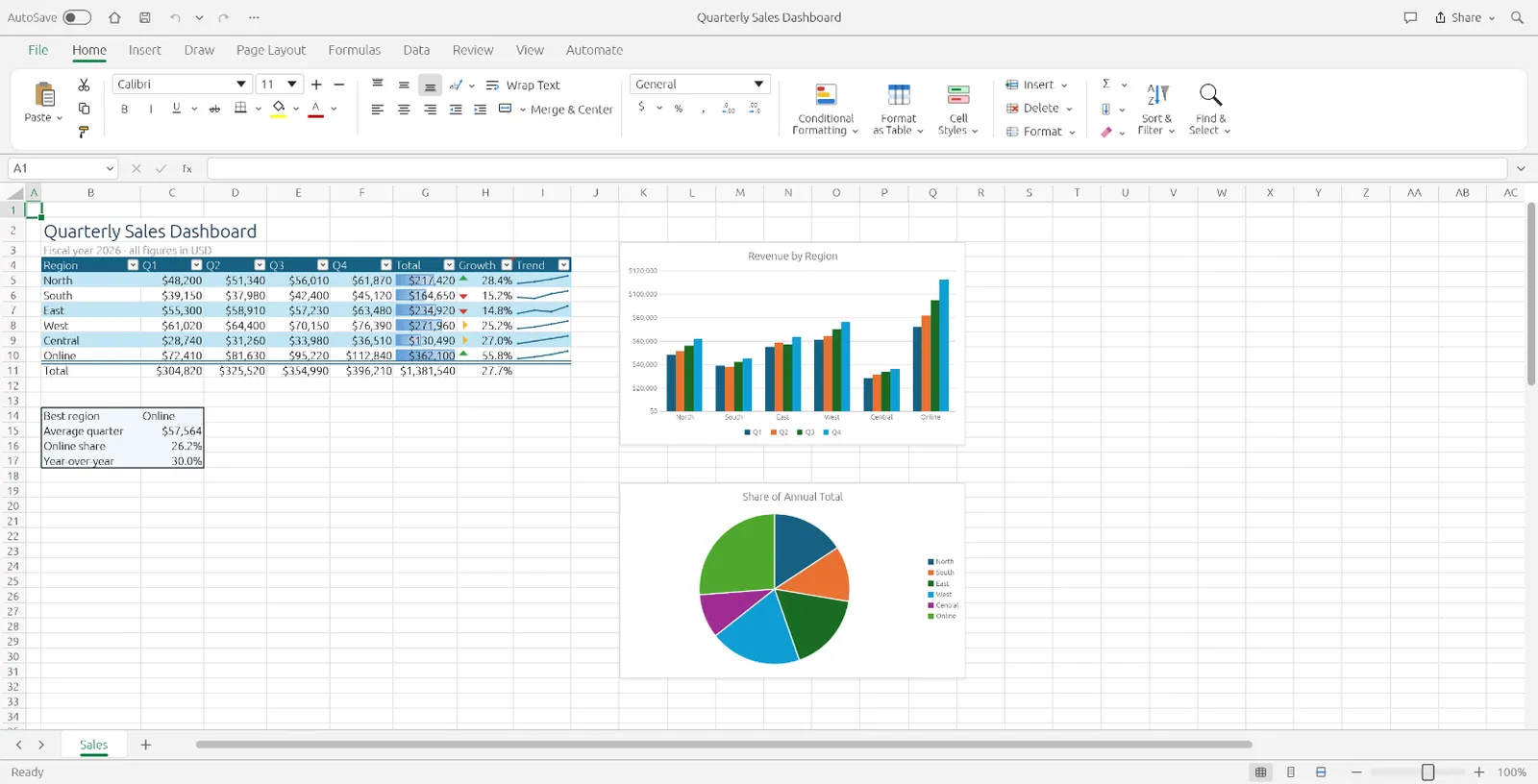
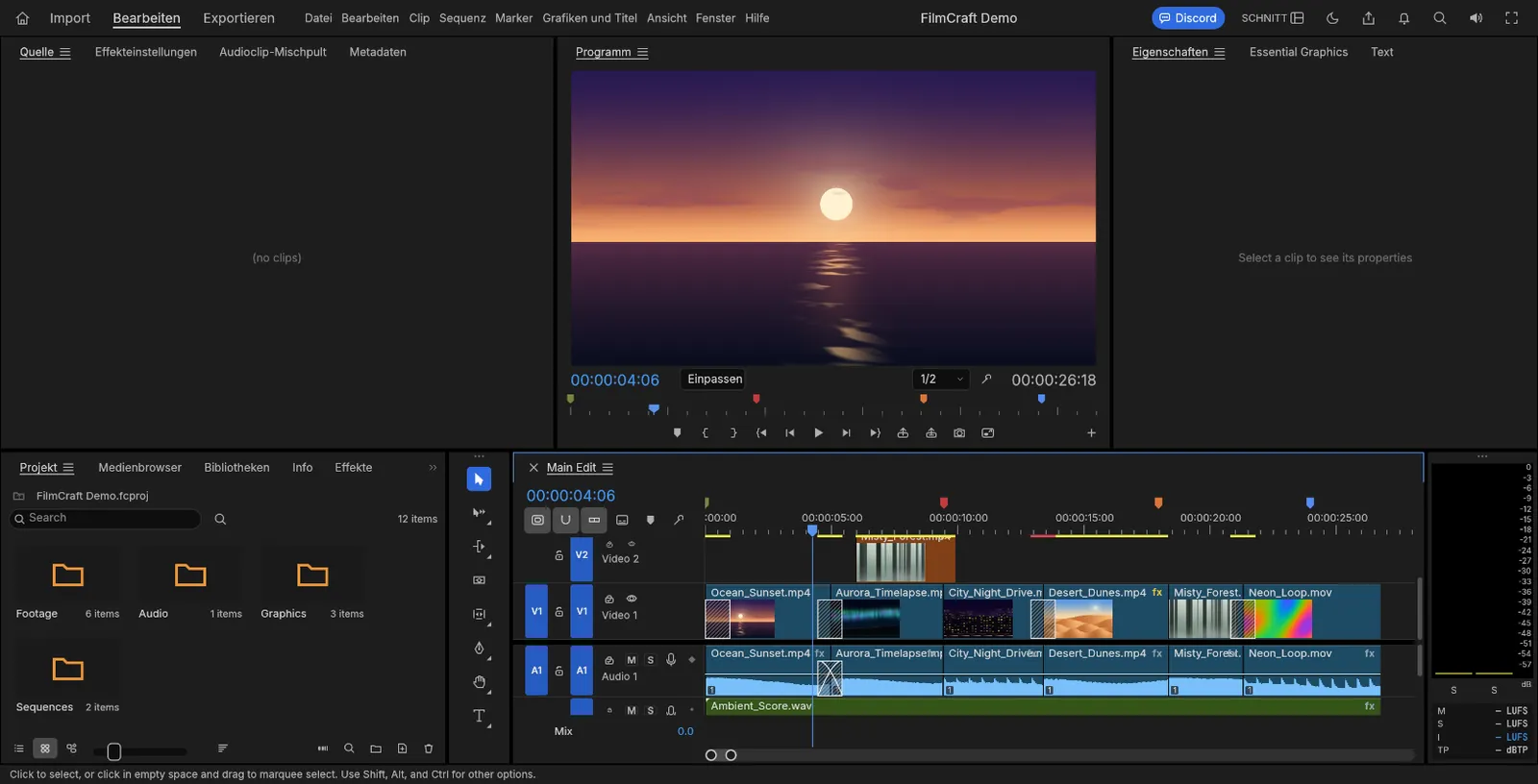
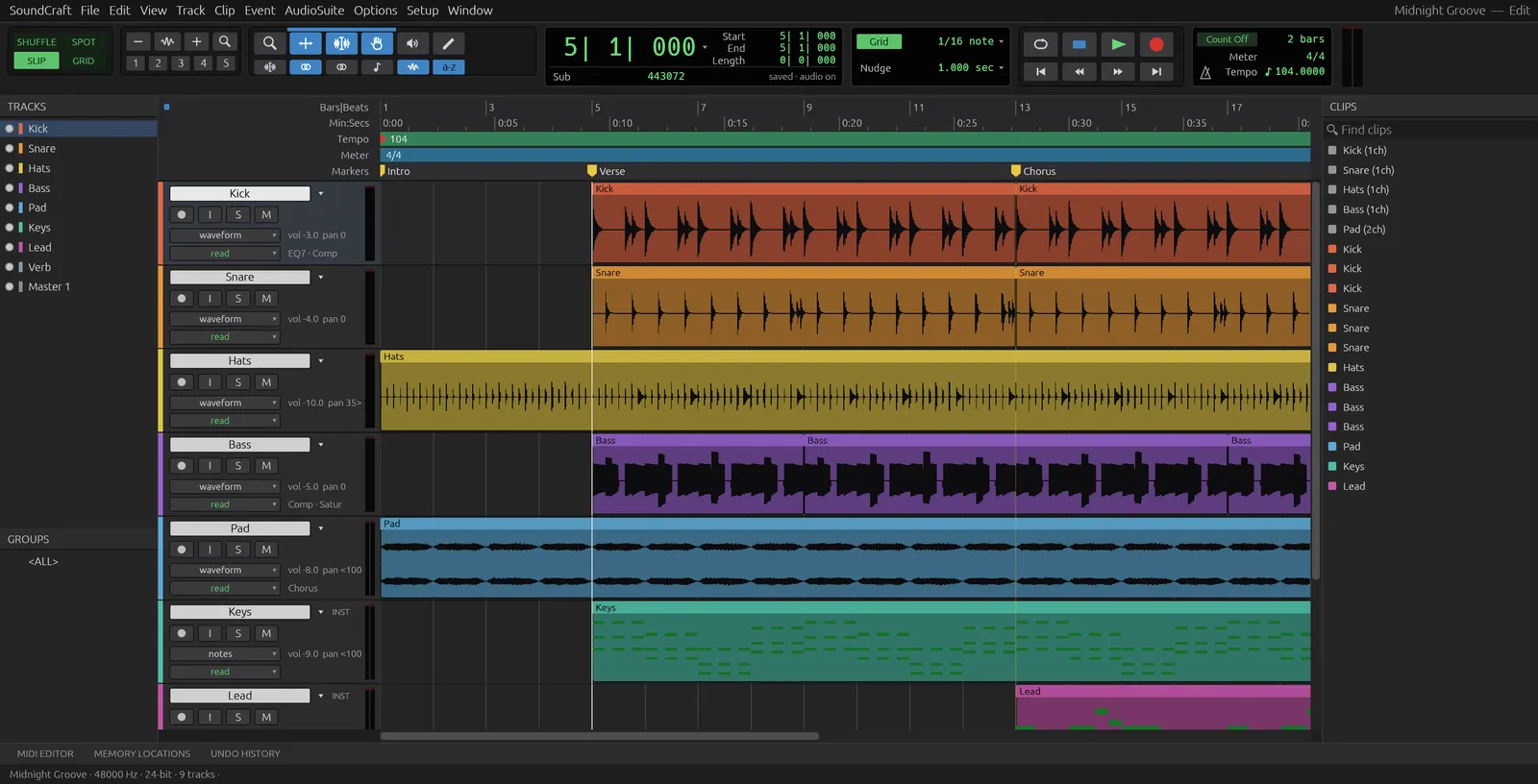
EffectCraft loses the graphics device
EffectCraft, the After Effects rebuild, showed the message "The graphics device was lost" a few seconds after loading over HTTPS. Over HTTPS the browser uses WebGPU. When the same Chromium opened the page over plain HTTP, EffectCraft fell back to WebGL2 and showed its sample composition with eight layers, a timeline and a preview. Two loads in a row behaved the same. The dialog itself is intended: two pull requests of the project (numbers 673 and 675) deal with a lost graphics device and a matching dialog. Why the device is lost in our case, we do not know. Only one browser on one machine was checked, and whether the automation plays a part has not been investigated.
What we did not check
We opened no real files. Whether an xlsx workbook, a Word document or a layered PSD arrives the way it looks is still open, and that is where the usefulness is decided. Speed on large files, other browsers, other graphics cards and saving are open too. PdfCraft states on its start page that it works offline, without telemetry and without an account. That is the project's own statement. For all twelve programs we recorded the network requests of the first six seconds: each one contacted only its own server and none a foreign one. That holds for the idle time after start, not for working with files.
What follows
The test shows something the program lists do not. That a rebuild has an interface with sample content you can open in a browser two weeks after the first commit is cheap by now. Whether it handles our files reliably is the question none of the documents answers. Whoever rebuilds or adopts a product inherits maintenance, not a community, and for a shipped work the contact person in an emergency is not settled at first.
What does not get cheaper
The LibreOffice retrospect is worth it because it shows the cost question predates the models. The roots lie with Star Division from 1985, Sun bought the company in August 1999 for 59.5 million dollars, reportedly because that was cheaper than licensing Microsoft Office for its 42,000 employees. The code opened as OpenOffice.org in July 2000, and on September 28, 2010 the Document Foundation announced the fork LibreOffice. What changed in the current round is the time axis.
What stays expensive is whatever cannot be decompiled: maintenance, security response, liability, evidence for audits and insurance, a contact person who stands up when something breaks. The three cost blocks of any rebuild deserve separate arithmetic. Code, a line item that has fallen, with the agent-hours above as the receipt. Interfaces and data, export paths, import formats, requirement sets for add-ins, retirement dates of old interfaces. Responsibility, who answers when the program behaves differently than promised and who can still answer that in three years. For a purchased product that question has an address, for a built one it is open at first. What self-operation versus buying means for evidence and control is covered in NIS2 and Self-Operation: Compliance through Control.
What stays open over the next weeks
The projects ship new versions several times a day, so the figures in this article have a shelf life of days. Three things will be decided soon. First, whether the projects' self-assessments hold up against independent checks: the parity documents for PhotoCraft and WordCraft state their method, and someone outside the projects can recompute them. Second, how the question about training data gets answered, which the clean-room statement leaves open. Third, whether the pile of programs turns into a maintenance community or each repository stays with its main author.
For our own check the next step is clear. We open one real file per program: an xlsx workbook with formulas in GridCraft, a document with styles in WordCraft, a layered PSD with text in PhotoCraft, a PDF with form fields in PdfCraft. Then we compare the result with the original and note what gets lost. EffectCraft also gets a second start on another machine with a different graphics card, which shows whether the lost device comes from the browser, the machine or the app. Until then the test site stays inside our network.
Further reading
- Chris Lewis: Decompiling a Nintendo 64 game in 84 days, August 26, 2026, with the repositories snowboardkids-decomp, snowboardkids2-decomp and Pilotwings64Decomp
- Storytold/PhotoCraft with parity assessment and roadmap, Storytold/WordCraft, ArtCraft program list
- AnyPS5, verified compatibility list, status page with counters, ps5-doom, pkg-to-anyps5
- Robbie Tilton: Compositor
- Directive 2009/24/EC, Article 6 decompilation and Article 8, Directive 2001/29/EC, Article 6
- Judgment C-355/12 Nintendo v PC Box of 23 January 2014, section 1201 US Copyright Act, Adobe general EULA, section 3.3(b) bans and section 10.2(b) decompilation in the EEA
- LibreOffice on Wikipedia for the lineage Star Division, Sun, OpenOffice.org and the 2010 fork
- GridCraft README, section Web (running the web version), release v0.5.0 with the file gridcraft-web-0.5.0.zip, EffectCraft pull request 675 on the lost-device dialog and pull request 673
- Video 1: Video Game Esoterica on the PS5 rebuild on PC, Video 2: Hood Informatik on assessing this development
Does a complete decompilation mean an AI system understands the program?+
No. The author separates the two carefully. A hundred percent match means every function has a C implementation that reproduces the original machine code. Whether each function is documented and named is a different question, and that work lies ahead.
Are the new clone apps an alternative to Photoshop and Word yet?+
By their own assessment, no. PhotoCraft is in alpha at roughly 45 percent readiness for daily work, WordCraft at roughly 60 percent. Those figures come from the projects' own parity documents, measured against installed copies of the originals.
Does buying a disc allow running the game on a PC?+
Those are two separate questions. One is copyright in the code, the other is protection of technical measures against removing the copy-protection mechanism. Buying a disc answers only the first. This is a decision for a legal team, not a setup command.