 senn-tech
Engineering studio · Kufstein, Tyrol
On-prem. Cloud. AI.
Your IT from one source.
Applications, infrastructure and language models; on your own hardware, in the cloud, or a mix of both, whichever adds up. From Kufstein, for mid-sized companies: one contact from the first sketch to production, and an honest assessment before any budget moves.
Services
Six disciplines, one stack.
01 · Apps
Enterprise applications
Business software that grows out of the actual need rather than a spec document: calculators, mobile data capture, ERP integration, automated workflows. Iterative with your team, in use early.
Next.js · Kotlin · n8n · REST
02 · Web
Websites & online shops
Company site, landing page or shop; built, not clicked together: multilingual, fast, no plugin sprawl, and an editing system your people can actually operate. This site is the working example.
Next.js · Kirby · Medusa · Stripe
03 · Data
BI, data lake & SQL
Figures from ERP, shop and accounting in one place: SQL servers, ETL pipelines and dashboards that are already right first thing in the morning. From a KPI cockpit to customer analysis.
Metabase · SQL Server · PostgreSQL · ETL
04 · LLM
Corporate LLM stack
Language models in your own building: inference, RAG over your documents, agents and document processing. Not a single token leaves your network, not even for analytics.
- Case study: in-house enterprise AI stack
- EUR 261 in-house instead of EUR 7,640 API
- Qwen3.8-27B on 4× RTX 5090
vLLM · Ollama · Qdrant
05 · IT
Infrastructure & operations
The foundation all of it runs on: Proxmox clusters, high-availability storage, firewalling, monitoring and mail. Planned, built and looked after, including when something fails at night.
Proxmox · HA storage · OPNsense
06 · SEO
SEO & GEO
Getting found: on Google and inside AI answers. Technical SEO, structured data and content, plus our own rank tracking instead of an agency report. GEO means ChatGPT and Perplexity should cite you too.
Matomo · Schema.org · IndexNow · rank tracking
Why senn-tech
No sales layer, no slide deck, delivery.
On your own hardware, or in the cloud
Language models can run on GPUs in-house, so no document ever leaves your network. Where your own hardware is out of budget, the same build runs on rented GPU capacity inside the EU.
One contact
You talk to the person who builds it. No sales layer in between, no handover to a team that lacks the context.
From application to operations
Application, model and operations come from the same hand, exactly where projects usually break at the seams.
Costed like a business
Twenty years in IT plus a commercial background: before we start, you get the number at which the project pays for itself.
Forward-deployed AI engineering, with model freedom
The engineer sits inside your operation and has no sales team in between. AI is deployed straight into your processes and evolved there. And the models stay yours to choose; swappable behind a gateway without users noticing a thing. No vendor lock-in.
Honest about no
If a process fix is cheaper than AI, that is what the proposal says. A project that does not pay off helps neither of us.
years of industrial IT
workplaces run in-house
inference on our own GPUs
compliant, on-prem or EU cloud
How RAG works
Sourced answers, live from your data.
Retrieval-Augmented Generation couples the language model to your real documents: no hallucinations, traceable answers.
Live demo
Talk to the stack.
This chat runs on the in-house AI server in Kufstein, no external provider, nothing shared. The same setup can sit in your building.
Responses are generated by a language model and may be wrong.
How we work
From idea to something in production.
01· 1 call
Conversation & analysis
We clarify the goal, the data and the constraints, and whether AI is the right lever at all. About an hour, no obligation.
02· 2–4 weeks
Prototype
Something running you can actually use, instead of a concept paper. You see early whether the direction is right.
03· ongoing
Production
Built cleanly, secured, monitored, on your infrastructure or ours. And we stay reachable afterwards.
Projects we run ourselves
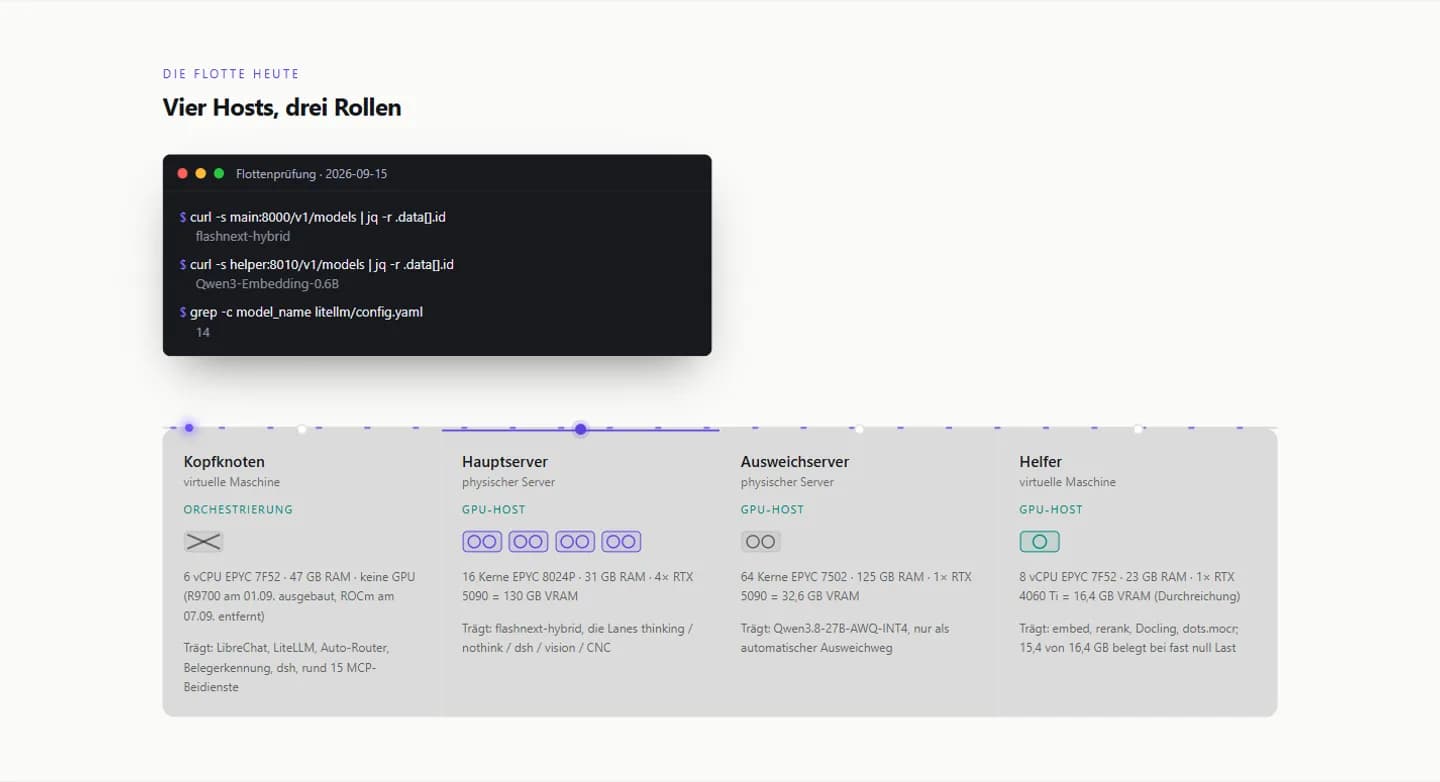
Enterprise AI stack, built in-house
Four GPU hosts, one model family for every chat lane, automatic failover and an honest look at five weeks of rebuilding.
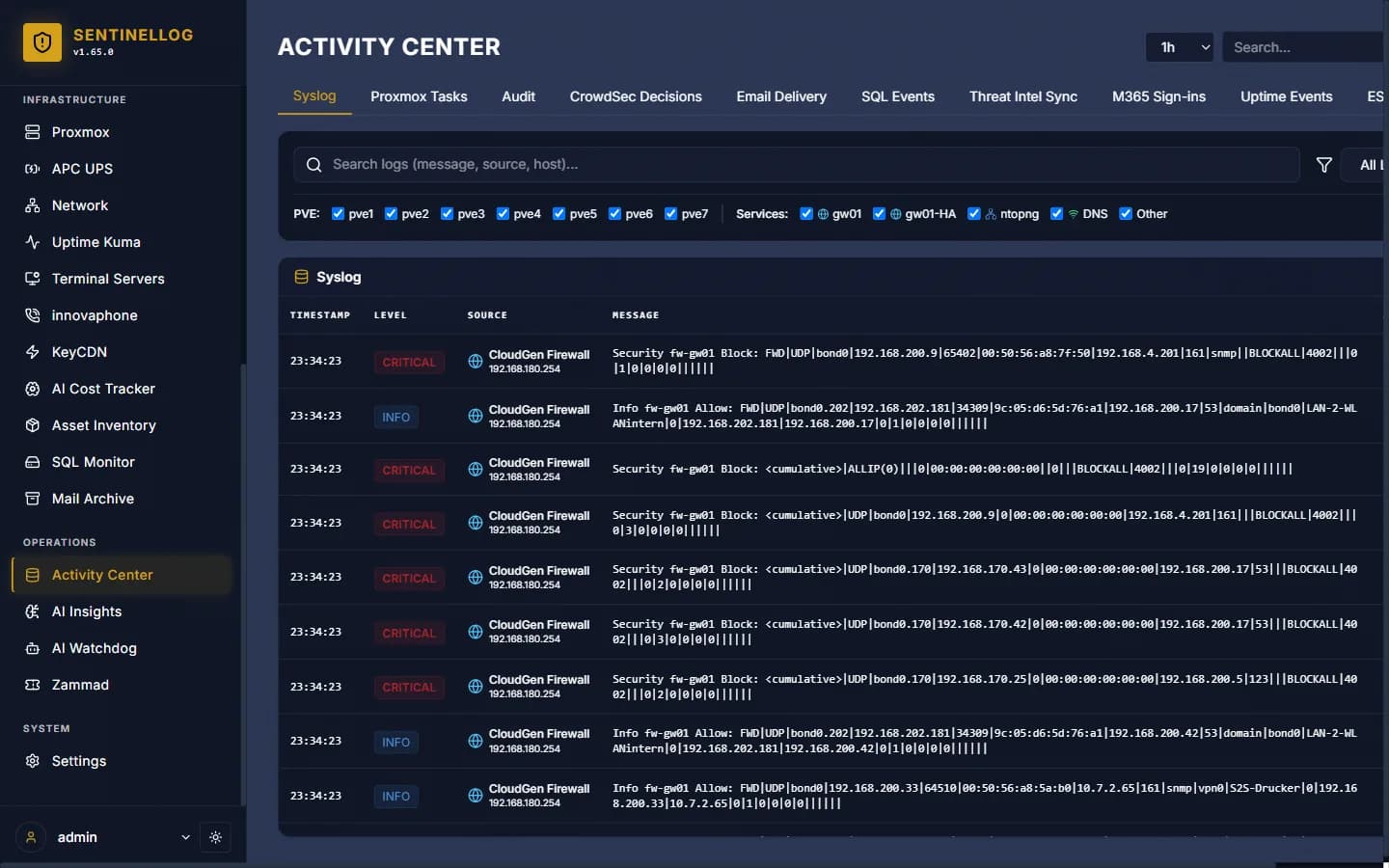
SIEM & security monitoring with real-time correlation
Company-wide logs in one place, and only the alerts that matter.
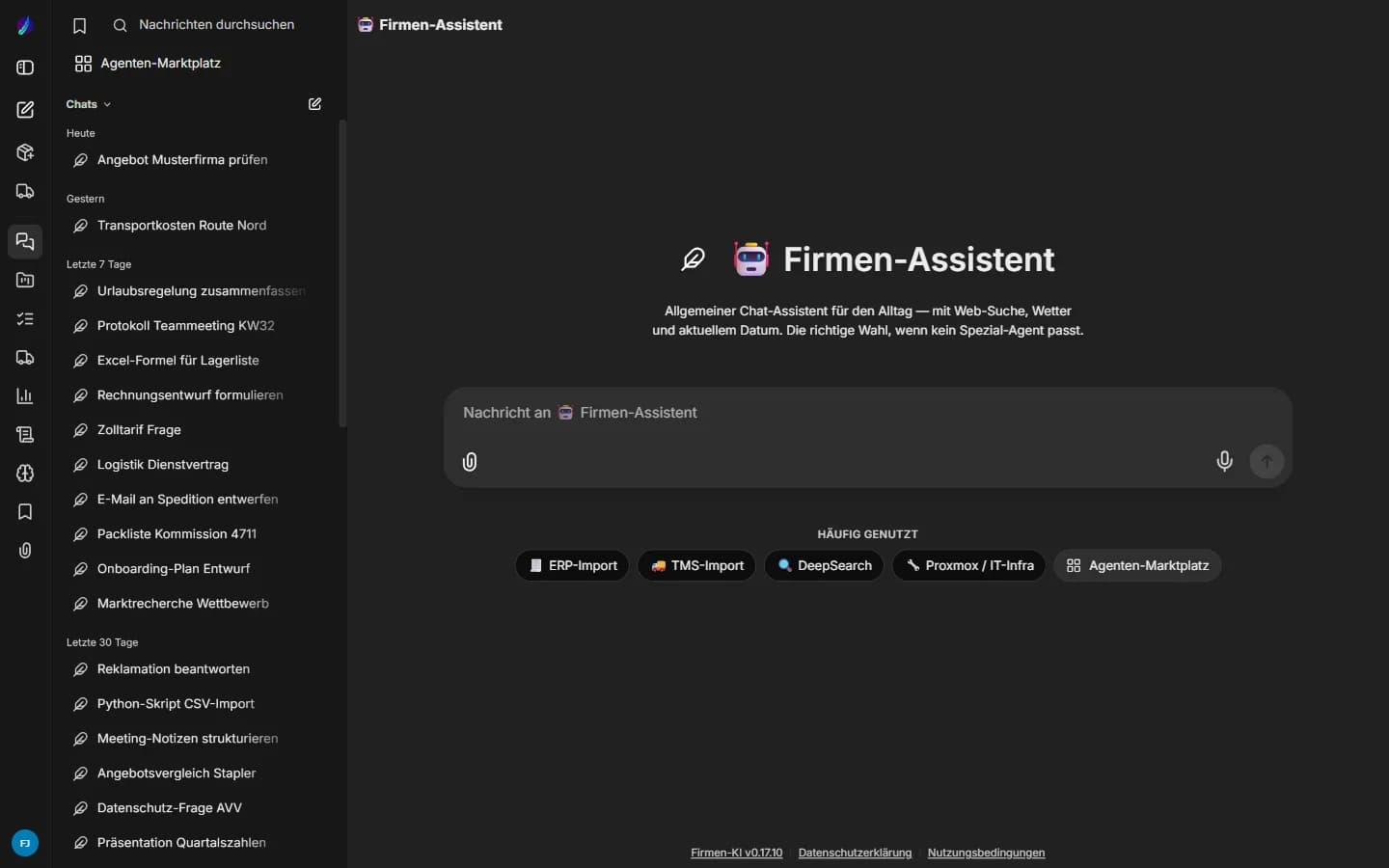
Company AI portal on its own GPUs
ChatGPT comfort in-house: 5 models, 32 tools, ~90 user accounts. Chats and documents stay in-house.
FAQ
Frequent questions.
Does our data really stay in-house?
Telemetry and metrics travel the same route, there is no second path out of the building. In the conversation we trace a setup's data flows far enough for you to judge them yourself.
Do you work with smaller companies too?
Yes, from sole proprietors to mid-sized firms. Size and budget set the scope.
What does a project cost?
Work is priced in expansion stages, each at a fixed price rather than by the hour. What a stage costs is decided by how many systems need connecting and how much of the operation you want to run yourselves.
Can you integrate existing systems?
Usually yes. ERP, databases and existing tools get connected rather than replaced, that is normally the cheaper route.
What if AI doesn't make sense for our problem?
Then you get a quote without AI: often a form, a script or a shortcut inside the ERP. Those jobs are smaller and we still take them. Most of what comes later grew out of one.
Would we then depend on you?
Everything is handed over documented and runs on standard components others can keep operating. Nothing is built to depend on one person.
Tell us what you have in mind.
One short call is enough to work out whether it pays off, and what the sensible next step would be.
Get in touch