 senn-tech
RAG Environments Compared: Vector Databases, Chunking, Embeddings
An LLM answers questions only as well as its context allows. RAG, Retrieval-Augmented Generation; gives it exactly that: relevant documents before formulating an answer. The technique is powerful, but full of pitfalls.
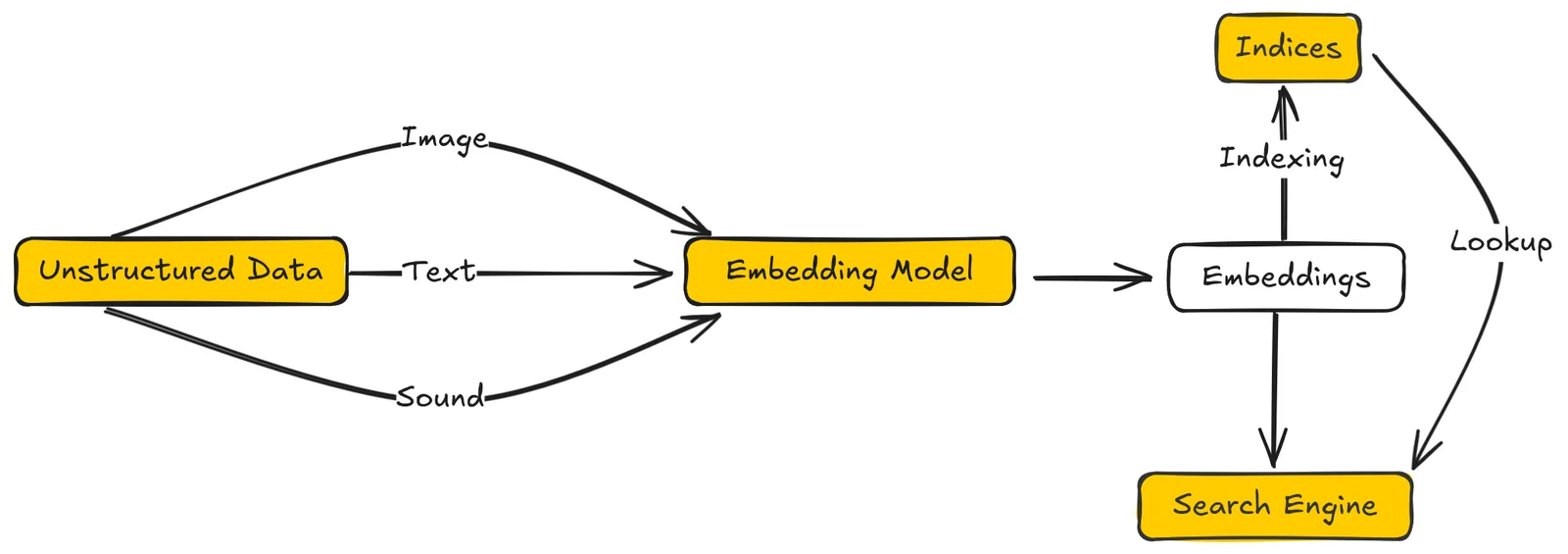
The RAG Pipeline
- Load documents: PDF, Markdown, HTML, code
- Chunking: Split documents into meaningful sections
- Embedding: Convert text sections into vectors
- Store: Persist vectors in a specialized database
- Query: On user question, find similar vectors and provide them as context
Each step influences whether the answer is correct or hallucinated.
Vector Database: Why Qdrant?
Qdrant is written in Rust, speaks gRPC and REST, and runs as a single binary. It needs no distributed cluster for medium-sized data sets and delivers sub-millisecond query times.
The filter API is the underrated advantage: you can filter by metadata in addition to vector similarity ranking, for example, "only documents from 2025" or "only from customer X." This makes retrieval more precise than pure vector search.
Chunking: The Underestimated Lever
Too-large chunks dilute the context. Too-small chunks tear sentences apart. The right size depends on the embedding model, typically 512 to 1024 tokens with overlap.
from qdrant_client import QdrantClient
client = QdrantClient(host="localhost", port=6333)
What matters is the overlap: a sentence that starts in the middle of a chunk loses context. 10–20% overlap is the pragmatic standard.
Embedding Models
For German mixed texts, multilingual models like intfloat/multilingual-e5-large deliver the most stable results. OpenAI embeddings are good, but for sensitive data they’re off-limits; embeddings contain semantic information and should not leave the premises.
Reality: RAG Is No Button
RAG works, but it requires trial and error. Which chunk size, which model, which retrieval strategy (dense, sparse, hybrid) depends on the document type. The first 80% accuracy is easy; the last 20% takes work.
Conclusion
RAG is not a product but an architecture. Qdrant makes the vector side simple. The rest, chunking, prompt design, evaluation, remains engineering work.
Further Reading
Do our documents have to be uploaded to OpenAI for RAG?+
No. For German-mixed texts a multilingual model like multilingual-e5-large delivers stable results locally. OpenAI embeddings are off-limits for sensitive data, because embeddings contain semantic information and should not leave the premises. The entire pipeline can run in your own network with Qdrant and self-hosted models, keeping the data in-house.
Is RAG a finished product you just switch on?+
No, RAG is an architecture, not a product. The first 80 percent accuracy is easy; the last 20 percent takes work. Which chunk size, which embedding model, and which retrieval strategy, dense, sparse, or hybrid; fits depends on the document type and requires trial and error. Chunking, prompt design, and evaluation remain engineering work.
Why Qdrant instead of a large database cluster?+
Qdrant is written in Rust, speaks gRPC and REST, and runs as a single binary, for medium-sized data sets it needs no distributed cluster and delivers sub-millisecond query times. The underrated advantage is the filter API: alongside vector ranking you can filter by metadata, such as only documents from 2025 or only from customer X, making retrieval more precise.