 senn-tech
M5 Ultra: the first measured numbers for local language models
Our comparison of Mac Studio, Strix Halo and DGX Spark on 6 September ended with a sentence that has followed us since: nobody had measured the M5 Ultra yet. Since 21 September there are measurements. Federico Viticci spent four days for MacStories putting an M5 Ultra with 256 GB against an M3 Ultra with 512 GB, Alex Ziskind lined both machines up with the same builds of llama.cpp and MLX, and Alex Grankin has compressed the published numbers of every review into one generation ladder. The spec sheet is not lying this time, and the number everyone is quoting only applies to half of all requests.

The test setup
Ziskind runs the version with 80 GPU cores, 256 GB of memory and an 8 TB SSD for 14,299 US dollars, with the base model starting at 5,499. In Europe we sit at 12,429 euros, the price table is in our post from early September. The 512 GB tier follows at the end of October, the reference is an M3 Ultra with a stated 819 GB/s.
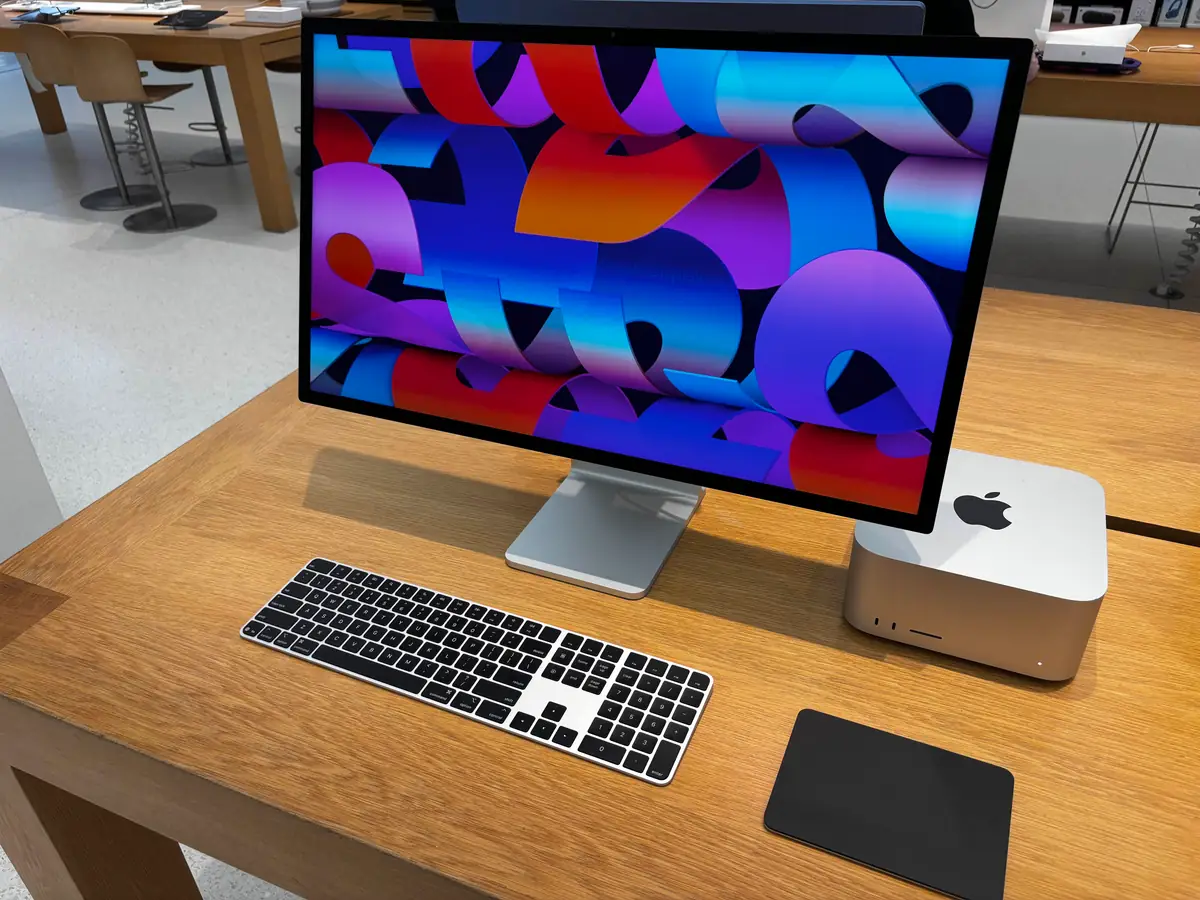
Of the advertised 1,200 GB/s, 1,039 arrive
The instrument first, because the whole verdict hangs on it. STREAM runs over the CPU and hands the M5 Ultra 583.6 GB/s against 312.9 on the M3 Ultra, a real number and the wrong question, since inference runs on the GPU. The microbenchmark from the GPU side gives 1,039 GB/s on the M5 Ultra against 724 on the M3 Ultra. Both reach 87 to 89 percent of the factory figure, the shortfall is the same across the generation, and the ratio between the measured values is 1.44.
Three models, two physics
Generating text pulls every active weight through memory once per token, so throughput follows bandwidth. Reading the prompt is GPU compute, and that is where the M5 Ultra carries the Neural Accelerators. Those two curves can now be told apart.
| Model | Type | Tokens/s M3 Ultra | Tokens/s M5 Ultra | Prefill M3 | Prefill M5 |
|---|---|---|---|---|---|
| DeepSeek V4 Flash, 284B | MoE | 37 | 53 | 483 | 1,485 |
| gpt-oss-120B | MoE | 90 | 130 | 1,300 | 3,200 |
| Qwen3.8-27B | dense | 37 | 54 | 430 | 1,800 |
The generation column sits at a factor of 1.4 to 1.5 on all three models, the prefill column runs from 3.1 to 4.2 times. One side value says more about daily use than any peak: after 64,000 tokens already in context, another 32,000 cost 80 seconds on the M3 Ultra and 56 on the M5 Ultra.
Across the generations: three years of standing still, then a leap
Every review measures the same reference, Qwen3.8-27B at 4 bit. On that ladder M1, M2 and M3 Ultra all sit at around 30 tokens/s, the Ultra tier barely moved for three generations. The M5 Ultra sits at 46 to 54, 48 on average, the M5 Max at 30, an M4 Max at 23 and the new M6 mini at 10.
Grankin converts the ladder into one job that cost his M5 Max 9.2 minutes and 16,500 tokens of output: 5.0 minutes on the 5090, 5.7 on the M5 Ultra, around 9 on M3 Ultra and M5 Max, 28 on the mini. Which makes the mini a bad entry into local models.
What long context does to speed
The four-fold better prompt processing is half the story: the same machine writes more slowly the more context it carries. Viticci and Grankin measure the same curve on Qwen3.8-27B: 48 tokens/s on a short prompt, 39 at 64,000, 32 at 128,000 and 24 at 256,000.
The second effect sits in memory: every context costs additional RAM, and that RAM is already committed. GLM 5.3 Flash writes 32 tokens/s on 256 GB but only fits up to 128,000 tokens of context, above that the machine runs full. Qwen3.8-Flash-Next writes 88 to 100 tokens/s and tolerates any context. The architecture decides, not the hardware alone.

The four only starts at four thousand tokens
Apple promises up to 4.5 times the peak AI compute of the M3 Ultra. Ziskind measured at which prompt length that becomes an actual four: 1.6 times at around 350 tokens, 3.4 times at 1,700, the four in the log from roughly 4,500, and on a real prompt of 14,000 tokens he measures 33 seconds against 8. Viticci measures 150 percent more prefill throughput on average and 245 versus 102 seconds to the first token behind a 256K prompt. Grankin's figure for an 80 page paste of 32,000 tokens: 19 seconds on the M5 Ultra, 39 on the M5 Max, 77 on the M3 Ultra.
llama.cpp now addresses the Neural Accelerators
The video shows the llama.cpp startup log, once per machine. On the M3 Ultra the runtime reports has_tensor = false, on the M5 Ultra has_tensor = true. That is the path to the matrix units, the reason for the prefill jumps. Our note from September about LM Studio concerned the runtime bundled there, and the bug report is still open. Anyone buying checks the build in the directory and its startup log.
The leap costs electricity
During generation the M5 tier reports around 45 watts for GPU plus CPU against 36 on the M3 Ultra, measured at the package and not at the wall. At idle it stays below the previous model at 8 to 10 watts. Under sustained full utilization the curve goes above 400 watts while the M3 Ultra stays near 200, so efficiency per token rises by about twelve percent. Add audible fans and 43 to 44 degrees of case temperature.
How our 4× RTX 5090 holds up against that
Viticci asked the same Qwen3.8-27B on all three worlds, as GGUF Q4_K_M on the card and as an MLX build on the Macs. On a 6,000-token prompt the 5090 reads 3,031 tokens/s and writes 59, the M5 Ultra 1,701 and 48, the M3 Ultra 414 and 31. With 64,000 tokens of context the three write 49.6, 38.9 and 23.5. The 5090 only keeps those numbers with an 8-bit attention cache inside its 32 GB; when it has to spill layers over PCIe, the same runs fall to 4.6 to 1.5 tokens/s. Grankin sees the same ranking: the card reads about twice as fast as the Mac, the Mac writes about three times as fast as a DGX Spark, which no longer works at 8 to 9 tokens/s with 128,000 of context.
Our box is not comparable to that, and the point belongs in the text: four RTX 5090 with tensor parallelism are 128 GB of VRAM and not a single stream. After four days of continuous operation with Qwen3.8-27B under vLLM we sit at an average of 96 tokens/s across all concurrent requests, with peaks around 16,000 tokens/s of prompt throughput. That is throughput for a group, not the response time of one desk. What the Mac brings is memory: 256 GB, no spilling, no PCIe edge, nearly silent.

Our take
The measurements confirm our reading in one line and Apple's claim in another: the generation gain is the bandwidth gain, and anyone who read the spec sheet was not surprised here. The actual leap sits in prefill, and it hangs on a condition that appears in no headline. Anyone who only chats locally buys an expensive M3 Ultra. Anyone who wants to run agents with long context on a workstation now has a machine worth calculating with. Two things stay open: the 512 GB tier at the end of October, and measurements beyond a single person, since eight concurrent requests are said to give 134 against 75 tokens/s while Viticci's three concurrent requests deliver a combined 81.5 against 39.9. So we are not buying, and we keep measuring.
Further Reading
- Ziskind: M5 Ultra, Apple Wasn't Messing Around, 22 September 2026
- Grankin: M5 Ultra Is Out, 22 September 2026
- Viticci: Mac Studio M5 Ultra Review, MacStories, 21 September 2026
- Same day: Tom's Hardware, 9to5Mac, The Verge
- oMLX releases
- LM Studio, issue 2040
- Apple: M6 and M5 Ultra, 25 August 2026
- Photos: Mac Studio at the display, CC0; top view, CC BY 2.0, Paul Hudson
- Mac Studio, Strix Halo or DGX Spark, 6 September 2026
- Qwen3.8-27B self-hosted
- DRAM bandwidth on 4× RTX 5090
- llama.cpp and GGUF


How fast is the M5 Ultra for local language models in practice?+
Measured rather than calculated: 53 tokens/s generating with DeepSeek V4 Flash at 284 billion parameters, 130 tokens/s with gpt-oss-120B, 54 tokens/s with the dense Qwen3.8-27B. That is 1.4 to 1.5 times the M3 Ultra and matches the measured bandwidth of 1,039 against 724 GB/s.
Does Apple's four-fold prompt processing claim hold?+
Above roughly 4,500 prompt tokens yes, below that no. At around 350 tokens the gain is 1.6x, at 1,700 tokens 3.4x, and on a real 14,000-token code prompt 4.1x. Anyone who mostly chats notices almost nothing, anyone running agents with large context notices a lot.
Is the M5 Ultra faster than an RTX 5090?+
On a single card, no. MacStories measured the same Qwen3.8-27B in both worlds: the 5090 reads 3,031 tokens/s and writes 59, the M5 Ultra 1,701 and 48. The 5090 does run into its 32 GB of VRAM there, while the Mac with 256 GB never spills.
Should a company buy the machine?+
As a workstation for large context it is usable for the first time, and the 256 GB configuration costs 12,429 euros. Under sustained load the box pulls over 400 watts, so efficiency per token rises by only twelve percent. For a served endpoint our multi-card box stays the better calculation.
Is the new M6 Mac mini usable for local language models?+
Measured, no. 170 GB/s of memory bandwidth, 32 GB of memory at the top end and around 10 tokens/s on Qwen3.8-27B. A job that finishes after 5.7 minutes and 16,500 tokens of output on the M5 Ultra takes about 28 minutes there.
Which is better: 96 GB M5 Ultra or 128 GB M5 Max?+
The Ultra, as soon as the model fits in 96 GB. It reads a prompt about twice as fast as the Max and writes at roughly 1.5 times. Only when a model needs more than 96 GB does the memory of the Max decide.