 senn-tech
Inkling 2 Mini on an RTX 5090 with Squid5090
On one GeForce RTX 5090, Inkling 2 Mini produced 372.1 output tokens per second in our single-chat test. With four simultaneous requests, the last Squid5090 client waited 3.32 seconds for its first token. Generation speed matters to a coding session. For a shared service, the other users’ waiting time matters too.
Squid5090 is an inference server written in Zig and CUDA for Inkling 2 Mini on NVIDIA Blackwell. The server processes text and images and is designed for a single active request slot. For text output, the built-in DSpark drafter suggests multiple tokens. The target model verifies them together. The more suggestions that match, the less often the server needs to read the model weights from GPU memory for the next decode step.
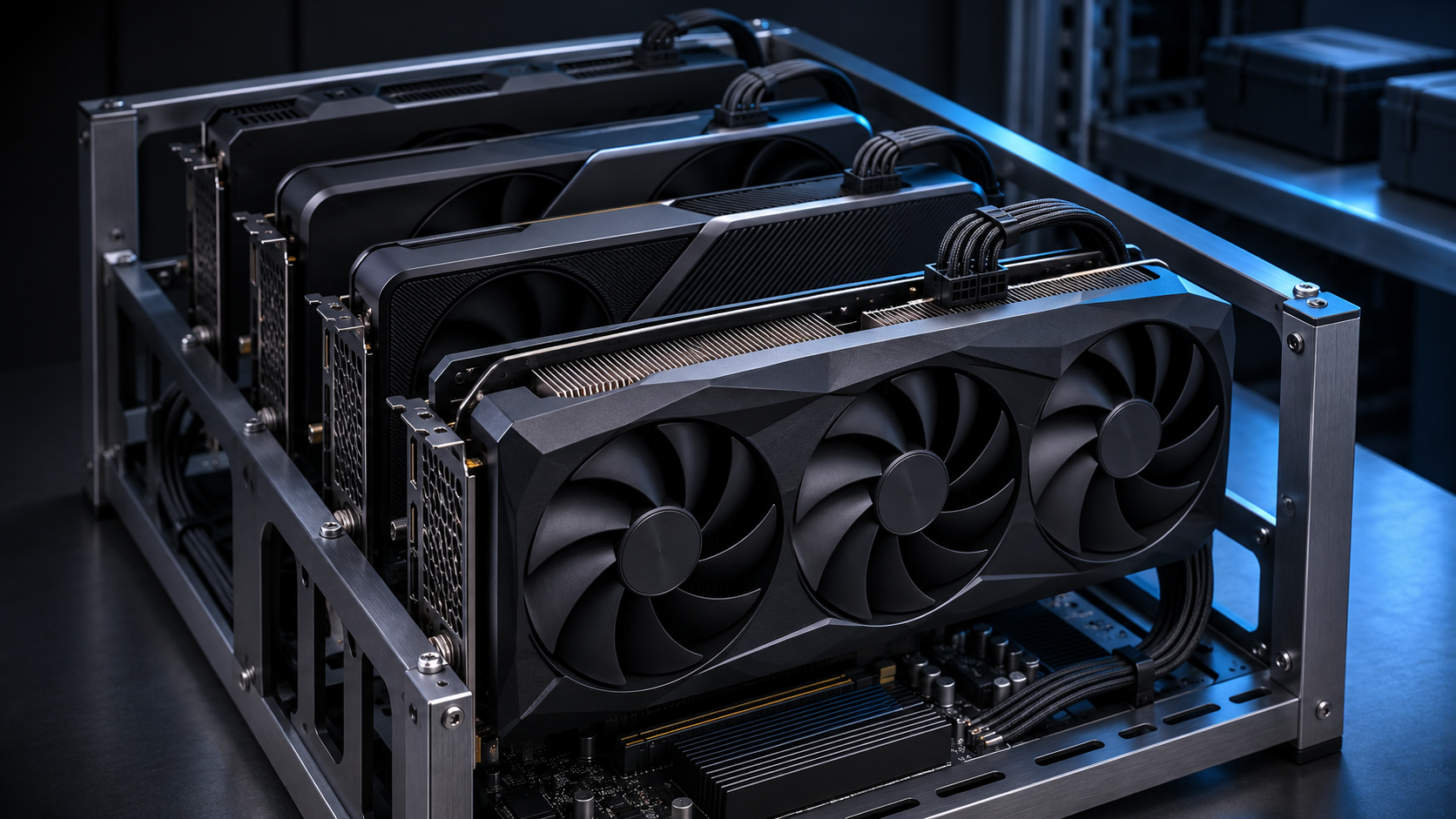
What the GPU does
Thinking Machines Lab has published the model weights and the built-in drafter. Inkling 2 Mini has 24 physical layers. A middle block runs three times, so the decoding path has 48 layer visits. The experts remain in the checkpoint formats in the tested Squid-FP8 configuration. Dense attention projections and the output head run in FP8. The breakdown of the model and its KV cache explains why weights and context require different memory budgets. Model card at the cited revision
CUDA graphs reduce the number of kernel launches from the host. Specialized Blackwell kernels group steps together and overlap parts of the memory accesses with computational work. During decoding, DSpark can avoid extra passes over the weights. We enabled and disabled it in the same Squid build. In the chat, the average rate of the two measurements at temperature 1 rose from 304.8 to 372.1 tokens per second, an increase of about 22 percent. During copying at temperature 0, it rose from 292.7 to 576.0. The project author’s article documents other prompts and reports 545.1 tokens per second for its copying test.
Benchmark results
Measured on November 26, 2026, UTC, on an NVIDIA GeForce RTX 5090 running Linux, driver 615.71.09. The Squid measurement used CUDA 13.4 and 32,768 context slots. The client calculated the rates from the output token count and SSE timestamps. Two repetitions were run per prompt type and setting, with a maximum of 384 output tokens. The numbers may include reasoning tokens.
| Measurement | Squid5090 | SGLang |
|---|---|---|
| Chat at temperature 1, output tokens/s | 372.1 | 189.7 |
| Prose at temperature 1, output tokens/s | 358.1 | 182.3 |
| Code at temperature 1, output tokens/s | 414.8 | 224.4 |
| Cold prompt with 18,857 tokens, time to first token | 1.225 s | 1.291 s |
| Four simultaneous requests, longest time to first token | 3.318 s | 0.187 s |
| Four simultaneous requests, aggregate output | 355.6 tokens/s | 469.0 tokens/s |
The servers ran on separate cards. Squid used FP8 for dense projections and the KV cache. SGLang used its native checkpoint path and BF16 KV. The table compares those configurations. SGLang processed multiple concurrent requests in the same batch. Squid served the four connections one after another. The load test consisted of a single burst of four requests. For shared on-premises AI infrastructure, I would first measure latency under the expected load.
At long context, repeating a request changes how much work the server needs to do. Squid took 1,183.9 milliseconds for server-side prefill of the cold 18,857-token prompt. On the identical repeat, it reused 18,432 tokens from the prefix cache and prefill took 112.8 milliseconds. On the warm requests, the client saw Squid’s first token after 156 milliseconds and SGLang’s after 51 milliseconds. This repeat measures reuse in an existing conversation. A fresh conversation or a change near the start of the prompt can change how much of the cache is reusable.
Context and answer quality
The fp8/q4 configuration with 524,288 slots received 516,092 input tokens with three identifiers at approximately 10, 50, and 90 percent of the input. With reasoning disabled, all three were returned exactly. The first token appeared after 118.47 seconds. In the 516,090-token trial with reasoning on, the model used all 100 output tokens on reasoning and returned no code. The 1,048,576-slot server started in nvfp4/q4 mode. The near-million-token request produced no response before the 405-second client deadline. For an interactive coding session, the initial wait on a full context can matter as much as the decode rate.
| Model and setting | Cases passed | Sum of the 21 request times |
|---|---|---|
| Inkling 2 Mini, Squid5090, normal reasoning | 18/21 | 21.6 s |
| Inkling 2 Mini, Squid5090, thinking disabled | 15/21 | 6.3 s |
| FlashNext Hybrid, vLLM, TP4 | 17/21 | 60.1 s |
The test covers arithmetic, code, German, adherence to instructions, tools, and context-based tasks. All runs used a temperature of 0 and the same tasks. FlashNext ran on four cards using a different model. These elapsed times describe the two tested deployments, including their models and request settings. In the fast Inkling run, 3,901 was numerically correct but failed due to the literal search for 3901. A discount calculation was incorrect, and a purported tool call did not contain a structured event.
For a narrowly defined extraction, enable_thinking: false can be useful. With eight documents, this setting returned eight out of eight responses that could be parsed as JSON objects and took an average of 1.36 seconds per document. Some fields differed from an earlier Qwen run. An import still needs checks for required fields, addresses and the ordering party. For general coding and tooling tasks, I would leave reasoning enabled. See the other local AI hardware benchmarks.
Sources and credits
- Measurement conducted by senn-tech, November 26, 2026 UTC. Measurement data as JSON · Illustrated measurement report as PDF
- Tensorfish, Squid5090 article, Git commit used and full acknowledgments in NOTICE, accessed on November 27, 2026. The project attributes key Blackwell kernels and optimizations to satellitedown and ingine. The NOTICE also credits Atomic Engine for prompt lookup, Sybil Solutions for measurement methodology, stb for image decoding and libwebp for the optional WebP build feature.
- Thinking Machines Lab, Inkling 2 Mini and Checkpoint, accessed November 27, 2026. DeepSeek, DeepSpec, and DSpark, accessed on the same day.
- SGLang, Integration pull request and Inkling-2 Mini Recipe, accessed November 27, 2026. Container digest
sha256:efac853b46811ccb760545b7b29e7119bdf907537ccf6e863fac3011fe8b98de. - vLLM, Release 0.32.0, base version of the locally patched FlashNext build. NVIDIA, GeForce RTX 5090, accessed November 27, 2026.
- Brand images in the PDF: Thinking Machines Lab via Wikimedia Commons and NVIDIA via Simple Icons v13. The hardware image is an original, AI-generated illustration created specifically for this report.


How fast is Inkling 2 Mini on an RTX 5090?+
Squid5090 in FP8 produced 372.1 output tokens per second in our temperature-1 chat test. With DSpark disabled it produced 304.8. Each rate summarizes two runs and can include reasoning tokens.
Can Squid5090 serve a million-token context?+
The NVFP4 server started with 1,048,576 context slots. A near-million-token request produced no response before the 405-second client limit. A request with 516,092 input tokens returned all three target codes.
When does disabling thinking help?+
The eight-document extraction replay returned eight parseable JSON objects in a mean of 1.36 seconds per document. The general battery fell from 18 to 15 of 21. Extracted fields still need validation.