 senn-tech
ASUS Ascent QN10 reviewed: 18 cores, an 80 TOPS NPU and no software that reaches it
ASUS sends the Ascent QN10 into the ring as a machine for local AI agents. 18 cores, an NPU rated at 80 TOPS, a chassis of 130 × 130 × 40 millimetres. The product page names the agents, OpenClaw and Hermes among them. We went through the measurement series, the data sheets and the prices, because the question is the same one every operation asks when it wants an inference box next to the desk.
The result runs in the opposite order to the marketing. The machine draws 5 watts at idle, with the fan standing still. It is just that the path to the language models goes past the NPU, and it does so on the operating system that ships on the device.
What is inside the case
| Field | Value |
|---|---|
| Processor | Snapdragon X2 Elite X2E-88-100, 18 Oryon cores (12 prime up to 4.7 GHz, 6 performance at 3.4 GHz), 65 W cTDP |
| Graphics | Adreno X2-90 at 1.70 GHz |
| NPU | Hexagon, 80 TOPS INT8 with sparsity |
| Memory | 32 GB LPDDR5X-8533, soldered, top configuration, no slot |
| Storage | 512 GB SanDisk SN5100S on PCIe 4, a second M.2 slot wired for PCIe 5 and left empty from the factory, up to 4 TB |
| Network | 2.5 GbE Ethernet (Realtek RTL8125BP), Wi-Fi 7 with Foxconn NCM820A |
| Ports | front: audio jack, 1 × USB 2.0 A, 1 × USB-A at 10G, 2 × USB4 at 40G; rear: 1 × USB4 at 40G, 2 × USB-A at 10G, HDMI 2.1, 2.5 GbE, barrel jack |
| Size and weight | 130 × 130 × 40 mm, 0.7 litres, 620 g measured |
| Operating system | Windows 11 on Arm, version 26H1 |
| Warranty | 2 years |
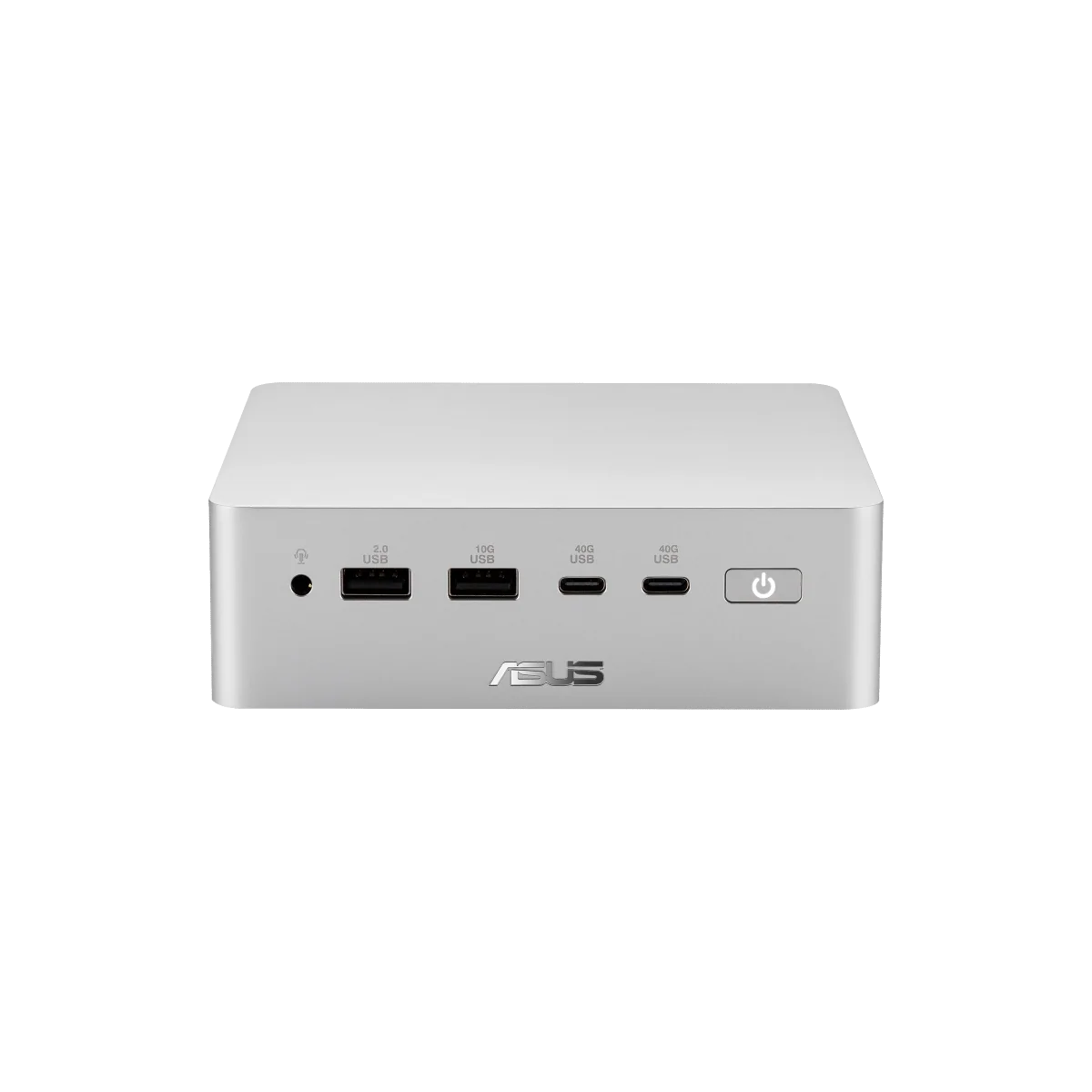
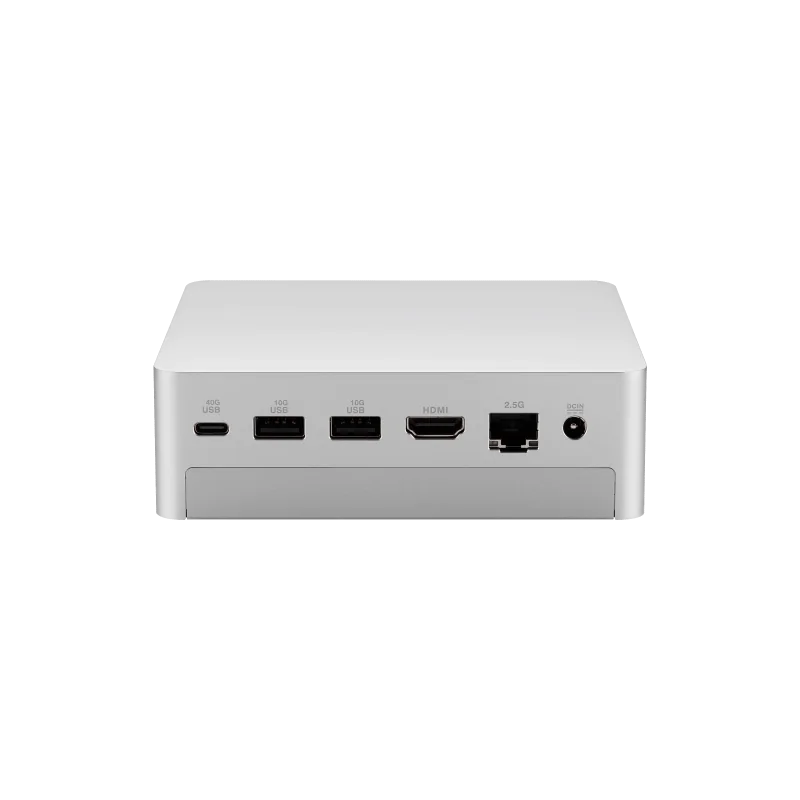

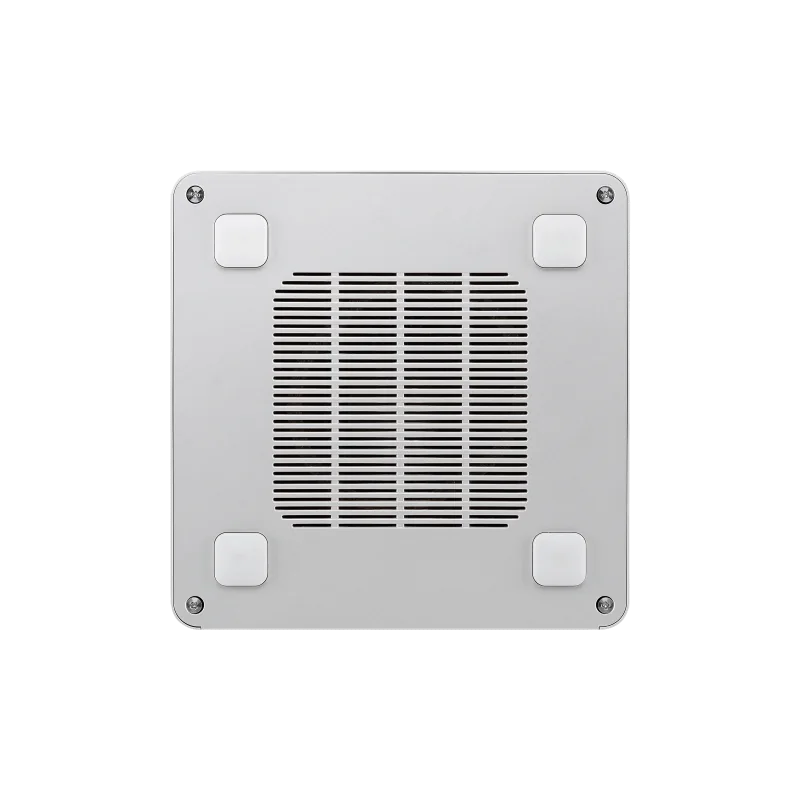
The documentation for this model is inconsistent in several places. The data sheet says 620 g and Bluetooth 6.0, the ASUS blog says 720 g and Bluetooth 5.4. The US page says 9600 MT/s, the global page 8533. The FAQ mentions two M.2 slots on PCIe 4 while the blog and both reviews say PCIe 5 plus PCIe 4. Anyone requesting a quote should have these points confirmed in writing.
The number that matters is not in the advertising
The X2E-88-100 is attached over eight LPDDR5X lanes, that is 128 bits. Qualcomm quotes 152 GB/s at 9523 MT/s; the review unit runs at 8533 MT/s, which works out at 136.5 GB/s. The 192-bit connection with 228 GB/s stays reserved for the X2 Elite Extreme. Figures of "68 GB/s" taken from the product page correspond to half a bus and should be read as an error.
During generation, every token pulls all the weights through memory. At an effective 110 GB/s and roughly 4.4 GB per token for an 8-billion model in Q4, that yields 25 tokens/s, and 25.2 were measured. Here the arithmetic and the measurement agree, which is rare.
| Model size | Footprint at 32 GB | Generation speed |
|---|---|---|
| 8B, Q4 | comfortable | around 25 tokens/s |
| 14B, Q4 | tight | around 13 tokens/s |
| 20B, Q4_K_M | cramped | around 9 tokens/s |
| 30B MoE with 3B active | last useful step | usable |
| 70B | not possible | none |
Why model choice hangs on this is spelled out in Why GPU memory bandwidth limits inference speed.
What the NPU actually delivers

In Geekbench AI 1.7.0 the QN10 reaches 91,477 points on the NPU in INT8, the best value in the comparison field. In FP32 it is 2,017 points. The gap between those two numbers explains both the advertising and its limit.
Measured with Procyon GenAI over that same ONNX path: 35.7 tokens/s with Phi, 25.2 tokens/s with Llama 3 at 8 billion, time to first token under 0.6 seconds, the CPU idle throughout. That is a good result for an NPU. It applies to models converted into Qualcomm's tools, with around ten billion parameters as the practical ceiling and 4,096 tokens of context in the shipped Genie builds.
For day-to-day work with open weights, the reviewer's sentence stands:
LM Studio and Ollama support neither the NPU nor the GPU on Snapdragon X(2) Elite today. Anyone using LLMs through these platforms, whether directly or indirectly through AI agents such as Open Claw or Hermes Agent, can only run them on the CPU.
Power draw, counted without embellishment
At idle we take 5 W at the wall, the fan is stopped, 28 dB(A), which is a good value. Under load the peak is 95 W at the wall, after which the machine settles at up to 80 W, 38 dB(A). On a tariff of 21 cents per kWh and 8,760 operating hours that makes two different machines.
So electricity price is neither a reason to buy nor an argument against. It only turns the argument around: efficiency at rest, not under work.
A second point belongs on a company network beside it. OpenClaw's operator went through a one-click code execution via the gateway URL in 2026 (CVE-2026-25253, CVSS 8.8). On top came an authentication bypass through spoofed loopback hops (CVE-2026-35656). And 335 planted programs were found on the ClawHub skill platform. Anyone running an agent continuously needs a cage for it: its own VLAN with default deny, gateway on loopback only, a separate account without administrative rights, an API key with a spending cap, weekly updates including an audit run. That list is laid out at greater length in The AI agent landscape in 2026.
Windows on Arm from an operator's seat
| Checkpoint | Status as of September 2026 |
|---|---|
| Kernel-mode drivers | Not emulable, and an x64 installer delivers no Arm64 driver. Test the VPN client, the antivirus agent and the scanner drivers beforehand, the catalogue is at worksonwoa.com |
| Windows version | 26H1 on build 28000, exclusively for new devices. 24H2 and 25H2 will never be raised to 26H1, and 26H1 reportedly will not take 26H2. One such device is its own ring in the update catalogue |
| Credential Guard | Bound to the edition: Enterprise or Education, not available on Pro. The data sheet lists Pro |
| TPM and BitLocker | On Qualcomm silicon from 2026 onwards, Pluton is no longer the TPM; the TPM function is delivered by the chip vendor's firmware TPM. Hardware-accelerated BitLocker is announced for Intel, for Qualcomm without a date |
| Snapdragon Guardian | A subscription service with its own MQTT channel into a Qualcomm cloud, no MDM partner named. On Ethernet the two vendors contradict each other: Qualcomm names physical Ethernet as unsupported, ASUS advertises recovery over 2.5 GbE LAN |
| Firmware | Updates exclusively through Windows Update, the download area for the model contains no tools |
For NIS2 and ISO evidence, the wording "Pluton-attested encryption" would be wrong. The protector and the attestation chain belong to a firmware TPM.
Linux: no path on this board
The processor itself has arrived: 18 Oryon-2 cores in the kernel since version 7.1, graphics for Adreno Gen 8 in Mesa 26.0, and the matching GPU firmware in linux-firmware since February 2026. On these platforms, though, enablement runs through a device tree per board, and for the QN10 none exists. The string "X2-90" appears nowhere in the kernel, Mesa or linux-firmware; upstream knows only Adreno X2-85. Qualcomm's own kernel branch carries no QN10 board, and there is not a single report of a Linux system booting on this device.
Two details sharpen that. The NPU achieves nothing under Linux: the FastRPC driver hangs on the first call, documented in issue 377 of qualcomm/fastrpc, and it does so even with Qualcomm's own GenieX packaging. And TUXEDO Computers dropped its Snapdragon laptop after eighteen months. The reasons given were battery runtime, missing BIOS updates under Linux, missing fan control, no foreseeable virtualisation with KVM and no high USB4 transfer rates. Four of them are what a Proxmox node needs: BIOS upkeep, fan control, KVM and USB4 rates. We covered comparable reasoning in an on-premise versus cloud bill.
Price and the alternative
The variant with 16 GB offered in the United States for 1,349 dollars has not been announced here, so it stays in the 2,136-euro class. ComputerBase calls the Intel NUC 16 Pro from the same house the rounder package in its closing section and recommends waiting, given NVIDIA's RTX Spark due in October.


Position
- As a workstation or kiosk PC: a good device. 5 W with no fan noise, four displays, native Arm performance at the top of the class. At 2,136 euro with a 2-year warranty, though, the NUC 16 Pro with 3 years and no driver lottery is the better procurement.
- As a host for language models and agents: no. The NPU stays out of reach for open weights, the CPU runs at 80 to 95 W doing the work, and 32 GB is the end of the runway.
- As a Proxmox node or distributed edge box: no. No bootable medium for this board, firmware only through Windows Update, no documented recovery path outside the operating system.
- Anyone wanting quiet local inference under Linux: an x86 mini with 32 to 64 GB, working power management, KVM and LVFS. Anyone working from 30 billion parameters up, or with several agents in parallel, will not get past 128 GB, see Mac Studio, Strix Halo or DGX Spark.
This device does not change the order of our procurement. What changes is the finding that "80 TOPS" and "agent PC" are two statements with nothing to do with each other as long as the toolchain is missing.
Further reading
- Running vLLM in your own operation: inference with throughput
- llama.cpp and GGUF: formats and their limits
- NIS2 in self-operation: what has to be documented
- Why GPU memory bandwidth limits inference speed
Further sources
- ASUS Ascent QN10, product page and technical specifications
- ComputerBase: ASUS Ascent QN10 review, 18-core CPU
- StorageReview: ASUS Ascent QN10 Review
- Qualcomm: Snapdragon Guardian overview in the API documentation
- Microsoft Learn: Pluton as TPM, as of 16 September 2026
- Microsoft Learn: Credential Guard, requirements and editions
- Ars Technica: Windows 11 26H1 as a separate version for new Arm PCs
- Phoronix: Mesa 26.0 with Adreno Gen 8
- Phoronix: TUXEDO drops the Snapdragon X Elite laptop
- GitHub qualcomm/fastrpc, issue 377: NPU bring-up under Linux
- NVD: CVE-2026-25253
- ASUS product-page image CDN, front shot
- ASUS product-page image CDN, rear shot
- ASUS product-page image CDN, underside
- Simple Icons, trademark files asus.svg and qualcomm.svg
- Geizhals: price comparison for the ASUS Ascent QN10
- E-Control: electricity price per kWh in the first quarter of 2026


All prices include VAT, collected on 21 September 2026 from Austrian retailers. Measured values come from the two linked reviews; our own calculations are marked as such.
Can the ASUS Ascent QN10 run large language models locally?+
Within limits. The 32 GB of LPDDR5X is soldered and cannot be expanded, and the memory bus is 128 bits wide. Dense models up to roughly 14 billion parameters run acceptably, a 30 billion MoE is the last useful step and 70 billion is impossible. During generation it is memory bandwidth, effectively around 136 GB/s, that limits throughput rather than compute.
Does Ollama use the NPU on the QN10?+
No. On Snapdragon X2 Elite, Ollama and LM Studio reach neither the NPU nor the GPU and run entirely on the CPU. The NPU is only reachable through the ONNX path with Qualcomm's QNN toolchain, at a practical ceiling of around ten billion parameters and 4,096 tokens of context in the shipped Genie builds.
Does Linux run on the ASUS Ascent QN10?+
Not as things stand. ASUS refers to Qualcomm, saying there are no plans to support Linux on the Snapdragon X2 Elite platform. The processor itself is upstream in the kernel, but no device tree exists for this specific board, and the string Adreno X2-90 appears nowhere in the kernel, Mesa or linux-firmware.
What does the ASUS Ascent QN10 cost in Austria?+
The only model listed in Europe, with 32 GB and 512 GB, stands at EUR 2,136 including 20 per cent VAT, shown as not in stock. The 16 GB variant sold in the United States for USD 1,349 has not been announced for Central Europe.