 senn-tech
Intrusion Prevention: CrowdSec instead of fail2ban
fail2ban blocks IPs after repeated failed attempts, locally, alone, reactively. CrowdSec does the same, but it shares the information with all other CrowdSec instances. An attacker who fails against another server in Helsinki won’t even get in here in Kufstein.
What this actually gets us in practice
We currently run four independent CrowdSec instances, among them the edge server that delivers this very website, plus our mail gateway and the two edge servers for senn-gruppe.com. Each has its own local API and its own SQLite database; decisions are not shared between the four instances, each detects and blocks entirely on its own.
On August 18, 2026, we watched live, on this website's own edge server, just how quietly a system like this can fail. Its access log was bind-mounted into the Caddy container as a single file, and Caddy ran inside as an unprivileged user. When the built-in log rolling tried to rename the file after reaching its 100 MiB threshold, it lacked write permission on the parent directory, from 05:19 onward, Caddy wrote not a single further line to the log. The service itself kept running flawlessly, no crash, no failed health check. CrowdSec reads exactly that log for its local detection: once the log stalled, detection stalled with it, frozen at the same byte. The only thing still active in the meantime was the static community blocklist with roughly 22,000 already-known bans, no detection of new attacks against us, just protection against IPs already flagged elsewhere. Even CrowdSec's own metrics looked unremarkable, because the counters were still there, they just weren't growing anymore. We fixed it the same day by replacing the single-file mount with a directory mount that Caddy and CrowdSec now share.
On top of that: the free tier of the central CrowdSec console was fully saturated for a stretch in July 2026, 3,052 alerts were dropped in that cycle. That only affected visibility in the central dashboard; detection and blocking kept running independently and unaffected on all four instances.
Both cases make concrete what the following section describes as a principle: the community list and the console are a useful safety net, but no substitute for our own local detection. That local detection is what actually needs monitoring, not just the service itself.
The Principle: Crowdsourced Threat Intelligence
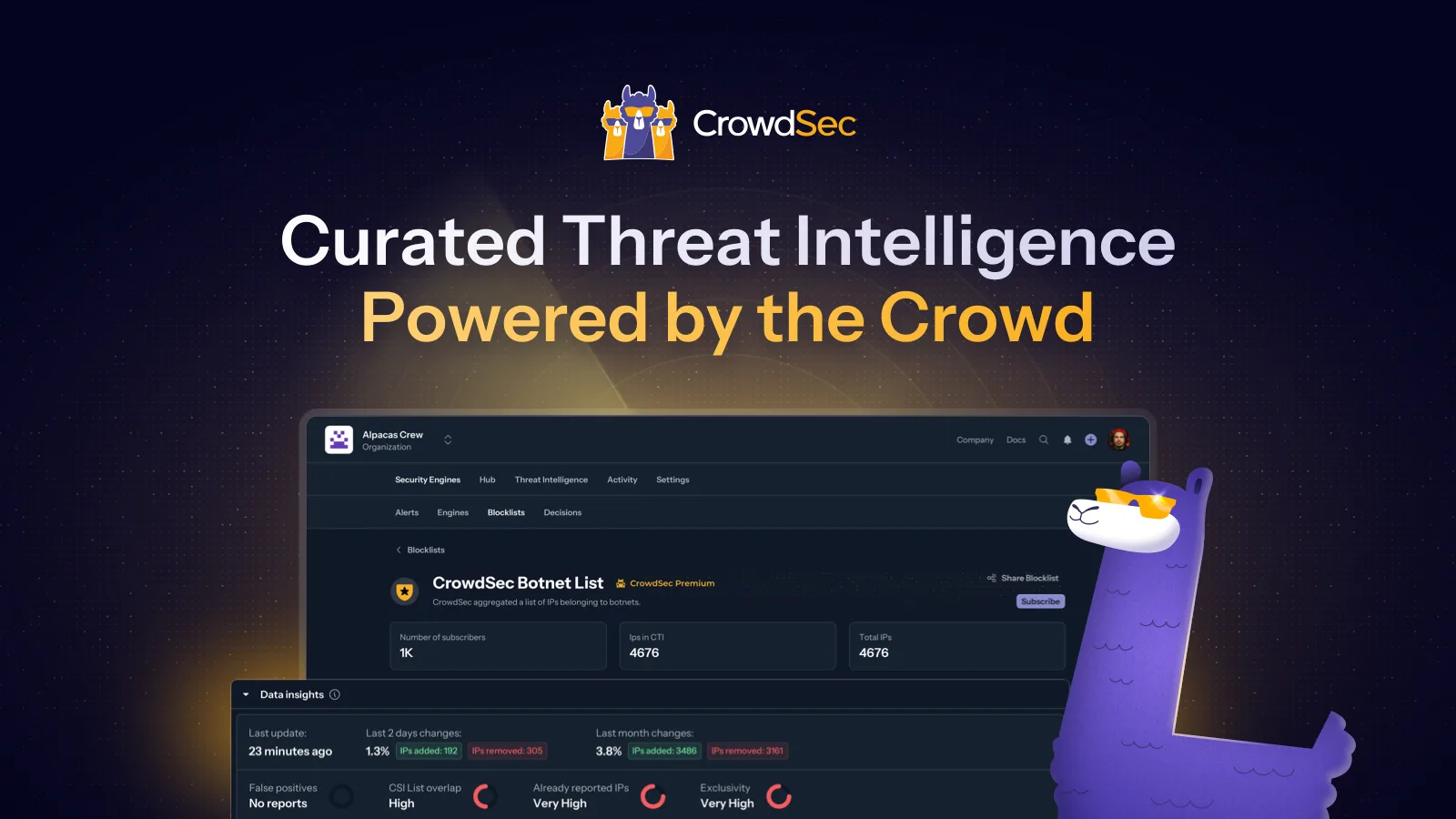
CrowdSec analyzes logs, SSH, HTTP, SMTP, name it. If it detects an attack (brute-force, scanner, exploit attempt), it blocks the IP locally, and sends an anonymized report to the central API. All other instances pull this blocklist and also fend off the IP.
This is no intelligence agency, but lived community: Whoever shares, benefits.
Installation: Docker, one command
docker run -d --name crowdsec \
  -v /var/log:/var/log:ro \
  -v crowdsec-config:/etc/crowdsec \
  crowdsecurity/crowdsec
Plus a Bouncer, for example the firewall Bouncer for iptables/nftables or the Caddy-Bouncer, and the logs are evaluated live. Setup takes half an hour, then it runs.
What CrowdSec does better than fail2ban
- Central blocklist management instead of individual jail.conf tinkering, one config file, all services
- Reputation: Not just failed attempts count, but the global history of the IP
- Modern parsing engine: Understands JSON logs, syslog, even custom formats
- No regex agony: fail2ban filters are regex puzzles. CrowdSec parsers are YAML and logical
More than IP blocking: AppSec/WAF
CrowdSec has grown beyond pure IP blocking. The AppSec component acts as an application‑near Web Application Firewall (among others with CRS-/ModSecurity‑compatible rules) and catches attack patterns directly at the HTTP request; useful for exposed web applications behind the reverse proxy.
NIS2‑compliant: on‑prem data retention
The threat data comes from an external API, but log evaluation and blocking run locally. No own log data leaves the premises; only anonymized signals ("IP X performed brute‑force against SSH"). NIS2-compliant threat sharing hardly gets better.
What fail2ban can still do better
For a single service on a single server that is never reachable from the internet, fail2ban is enough. The complexity of CrowdSec pays off only from the point where you are truly exposed, reverse proxy, mail server, SSH with internet access.
Conclusion
CrowdSec does not replace fail2ban as a niche tool, but as a standard IDS. Whoever operates more than two services publicly should use it. The swarm is stronger than the lone individual, that holds in security just as in biology.
Further Reading
What does CrowdSec do better than fail2ban?+
CrowdSec shares threat data across all participants. An attacker who fails elsewhere is not admitted here in the first place. Add central blocklist management instead of individual jail.conf tinkering, reputation based on an IP's global history rather than just failed attempts, a modern parsing engine for JSON and syslog, and YAML parsers instead of regex puzzles. Beyond pure IP blocking, the AppSec component acts as a WAF.
Do my logs leave the premises with CrowdSec?+
No. Threat data comes from an external API, but log evaluation and blocking run locally. No own log data leaves the premises; only anonymized signals such as a report that an IP performed brute-force against SSH. On-prem data retention and NIS2-compliant threat sharing thus do not exclude each other; whoever shares benefits from the swarm.
Is CrowdSec worth it for a single server too?+
Not necessarily. For a single service on a single server that is never reachable from the internet, fail2ban is enough. CrowdSec's complexity pays off only once you are truly exposed, reverse proxy, mail server, SSH with internet access. Anyone operating more than two services publicly should deploy CrowdSec.